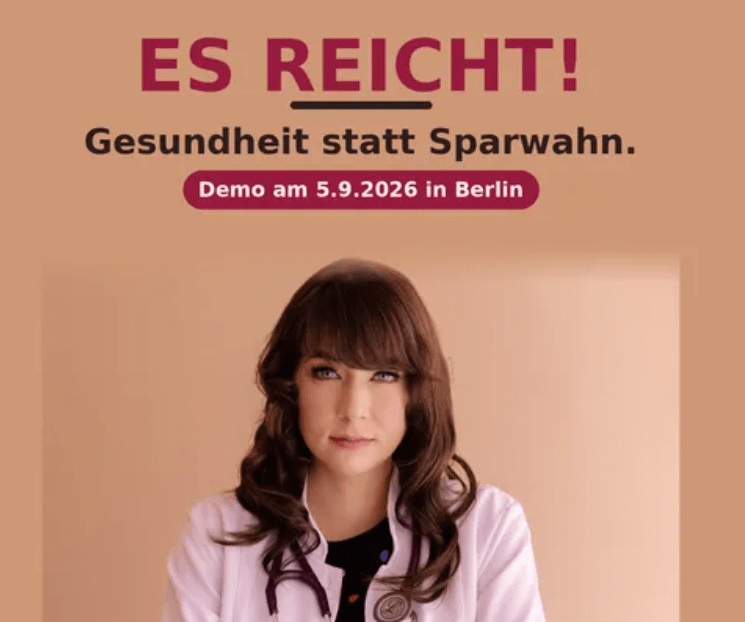
Dr. med. Bea Merscher, a pediatrician and mother of two who raises her children as a single parent, is calling on the public to support a planned demonstration focused on healthcare funding and the future of medical services in Germany.
Merscher, who is known on social media as Dr. Bea, says she has spent years informing hundreds of thousands of parents about children’s health while advocating for children, families, and access to high-quality healthcare.
She says she decided to organize the demonstration because she no longer wants to remain silent while concerns about healthcare cuts continue to grow. According to her appeal, she is particularly troubled by the possibility that healthcare could face further savings measures at a time when many patients and healthcare workers are already under pressure.
Her central question is why savings should be made in an area directly connected to people’s health and well-being.
Merscher contrasts those concerns with what she describes as billions of euros in taxpayer money being lost through planning failures, cost overruns, and unsuccessful major projects. She argues that healthcare should not be treated as an area where reductions are made without considering the consequences for patients, families, and medical professionals.
The planned demonstration is intended to bring together people working across the healthcare sector, as well as patients and other members of the public who share concerns about the direction of healthcare policy.
Merscher emphasizes that the demonstration is intended to be peaceful and democratic. Her goal is to create a public forum in which healthcare workers and patients can collectively express concerns and call for greater attention to healthcare provision.
To organize the event, she is asking supporters for financial assistance. According to her fundraising appeal, donations will be used exclusively for the organization and implementation of the demonstration.
Planned expenses include technical equipment, banners, printing, logistics, insurance, and other necessary costs associated with holding the event. She says the funds will not be used for unrelated personal purposes.
Merscher has also made a public transparency commitment. She says that after the demonstration, she will disclose all income and expenses so that supporters can see how the money was used.
She further states that every euro will be documented and that any potential surplus will not be used privately. Instead, she says, remaining funds would be allocated only after supporters are informed and only for the stated purpose of the campaign or another clearly identified public-interest purpose.
The appeal is directed toward people who believe healthcare should not be treated as a bargaining tool or an area where essential services can be reduced without consequences.
Merscher is asking supporters to contribute financially where possible and to share the campaign with others who may agree with its message. She argues that broader participation would help demonstrate the level of concern among healthcare professionals, patients, families, and members of the public.
Her appeal is framed around the belief that healthcare decisions can have direct consequences for people’s daily lives, particularly for children, families, elderly patients, and those who depend on medical services.
As a pediatrician, Merscher says her professional experience has strengthened her concern about the future of healthcare. Her public work on social media has also given her a platform from which to address parents and others interested in children’s health.
The demonstration is therefore being presented not only as a protest against proposed or potential healthcare cuts but also as a call for greater public discussion about how Germany’s healthcare system should be funded and maintained.
Merscher argues that citizens should make their concerns known through peaceful democratic participation. Her message encourages supporters to become involved rather than remain silent while decisions affecting healthcare are being debated.
The campaign’s fundraising appeal does not provide a complete breakdown of the specific healthcare policies or individual budget measures being challenged. Those details would need to be evaluated against official government proposals and public budget documents.
For now, the focus of the campaign is on building support for the demonstration and ensuring that the event can be organized with the necessary resources.
Merscher closes her appeal by urging people who share her concerns to stand together and make their voices heard. She expresses gratitude for every donation, regardless of size, and says that financial support and sharing the campaign can both contribute to the effort.
Her broader message is that healthcare should remain a central public priority and that decisions about savings and spending should take into account their potential impact on patients and healthcare professionals.
The campaign now seeks to turn those concerns into a visible public demonstration, with supporters being asked to help fund the practical arrangements needed to make the event possible.