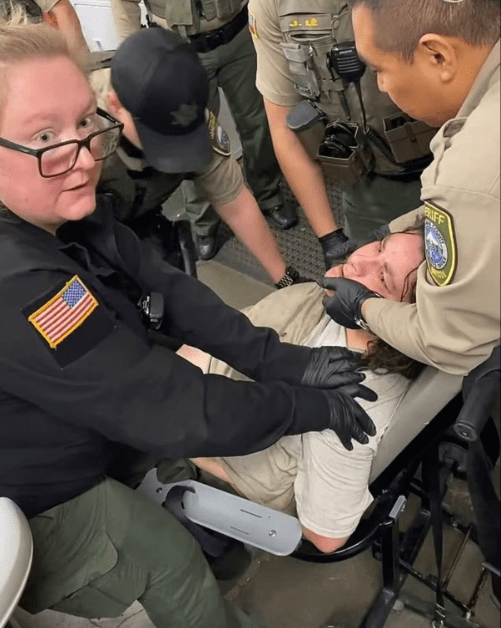
An Oregon woman repeatedly told deputies that she could not breathe while she was being restrained in a chair at the Clackamas County Jail, shortly before she became unresponsive and died, according to newly released jail video and investigative records.
Gerlinde Spring Lynch, 47, died shortly before midnight on February 18 after being arrested in connection with an incident outside a KFC in Oregon City. Police said Lynch appeared largely incoherent when officers encountered her and had soil around her mouth and leaves in both hands.
Authorities said an employee had reported seeing Lynch pulling plants from the ground, throwing rocks, and moving large landscaping stones around the restaurant’s drive-thru area. Officers ultimately arrested her after what they described as resistance during the encounter.
After arriving at the jail, investigators said Lynch refused to get out of the patrol vehicle and wrapped herself in the vehicle’s seat belts. Deputies described her as exhausted and breathing heavily before she was moved into the jail’s restraint process.
Video released from inside the facility shows multiple deputies attempting to place Lynch into a restraint chair while she struggled. During the encounter, Lynch can be heard saying, “I can’t breathe” at least twice and asking deputies to let her go.
The video has raised additional questions about what happened during the final minutes of Lynch’s life, particularly regarding her positioning while she was being restrained. Deputies eventually leaned Lynch forward to remove her handcuffs, which had been secured behind her back.
The process was complicated when a key reportedly broke inside the handcuff lock, delaying the removal for approximately one minute. After Lynch was brought upright again, one deputy asked whether she was still breathing.
A nurse was called to the area, and CPR was initiated after Lynch became unresponsive. Despite efforts to revive her, she could not be saved and was pronounced dead at approximately 11:42 p.m.
The Oregon medical examiner later determined that Lynch died from cardiac arrest associated with several contributing factors. Those factors included methamphetamine toxicity, physical restraint, obesity, and hypertensive cardiovascular disease.
Toxicology testing reportedly detected approximately 1,500 nanograms per milliliter of methamphetamine in Lynch’s system. The medical examiner classified the manner of death as homicide.
That classification does not, by itself, mean that a person committed a criminal act or that someone will be charged. In medical-examiner terminology, a homicide determination can refer to a death resulting from the actions of another person, even when prosecutors ultimately determine that there is insufficient evidence to establish criminal wrongdoing.
Lynch’s family is now pursuing legal action. Her father, Ted Riggle, has filed notice of an intention to pursue federal civil-rights claims and a state wrongful-death case against Clackamas County.
Attorney Chad Stavley, representing the family, alleges that deputies improperly positioned Lynch during the restraint. According to the legal notice, instructions associated with the restraint chair warned against leaning a detainee forward and directed that handcuffs be removed while the person remained seated upright.
Stavley alleges that Lynch was bent forward while multiple deputies restrained her. The notice also states that Lynch urinated on herself during the encounter, which the attorney cited as another indication of the severity of her physical condition during the restraint.
The allegations made by Lynch’s family and attorney have not been established in court, and Clackamas County officials will have an opportunity to respond through the legal process.
The criminal investigation, meanwhile, reached a different conclusion. The Clackamas County District Attorney’s Office previously determined that there was insufficient evidence to bring criminal charges against sheriff’s personnel over Lynch’s death.
Prosecutors said Lynch’s underlying heart disease, the toxic level of methamphetamine in her system, and her resistance during the restraint combined to create circumstances that ultimately proved fatal.
The district attorney’s office concluded that the evidence of criminal negligence fell substantially below the level required to prove a criminal case beyond a reasonable doubt. That determination meant no criminal charges were filed against the deputies involved.
Lynch’s history also formed part of the broader circumstances surrounding her final day. She had been released from state prison only five days before her death after serving approximately two years for first-degree criminal mischief.
Authorities also said Lynch had been arrested earlier on the same day she died on allegations that she trespassed and pulled up plants. She was released on her own recognizance several hours before the later incident outside the KFC.
The newly released video has renewed attention on the circumstances of Lynch’s death, particularly because her repeated statements that she could not breathe occurred during the moments immediately before she became unresponsive.
For Lynch’s family, the dispute now centers on whether the methods used during her restraint contributed to her death and whether deputies followed established procedures. Those questions are expected to be examined through the civil litigation.
For the county and law enforcement officials, the prior prosecutorial finding remains significant because it concluded there was not enough evidence to establish criminal negligence.
The case therefore presents two different legal assessments: prosecutors determined criminal charges were not warranted, while Lynch’s family alleges that the restraint was conducted improperly and contributed to her death.
Lynch’s death remains a painful and contested case involving questions about restraint procedures, medical vulnerability, drug toxicity, and the responsibilities of law enforcement when a detainee says she cannot breathe.
As the civil claims move forward, the evidence from the jail video, medical findings, restraint policies, and testimony from those involved will likely play an important role in determining what happened during the final moments of Gerlinde Spring Lynch’s life.